Isle Royale Backpacking: Routes, Maps and Tips
Updated: Aug 18
Isle Royale backpacking tips, routes, maps, and guidance for planning a safe trip through Lake Superior's remote island wilderness.

Remote, rugged and reachable only by boat or seaplane, Isle Royale National Park offers one of the most distinctive backpacking experiences in the United States.
The park has 165 miles of hiking trails and 36 campgrounds spread across a Lake Superior archipelago of more than 400 islands.
Jon Prain, known as “The Isle Royale Guy,” is a seasoned backpacker who has spent many years helping others understand and prepare for this unusual island wilderness. He joined the Lake Superior Podcast to share lessons from his many trips. In his Lake Superior Podcast conversation about backpacking Isle Royale, he emphasizes preparation, self-sufficiency, and the value of slowing down.
One of the most captivating aspects of Isle Royale is the deep spiritual connection it fosters with nature.
The island's tranquility and remoteness allow visitors to disconnect from the chaos of everyday life and truly immerse themselves in the surrounding beauty.
As Prain aptly puts it, Isle Royale is a place where the barrier between humanity and nature is thin, allowing visitors to feel closer to nature and appreciate the wonders of the world around them. Every sunrise, every moose sighting, every narrow trail brings an unparalleled sense of peace and connection. The rugged terrain, crystal-clear waters, and abundant wildlife create a tapestry of natural beauty that leaves a lasting impact on visitors.
Isle Royale backpacking at a glance
Season: The park is open from April 16 through October 31, but scheduled ferries and seaplanes generally operate from mid-May into late September. Spring and fall services are limited.
Access: There are no roads or bridges to the island. Arrive by ferry, seaplane or private boat.
Backcountry camping: The park has 36 designated campgrounds. Every campground has tent sites, access to a natural water source and a privy; some Lake Superior shoreline campgrounds also have three-sided shelters.
Permits: A backcountry permit is required for every overnight stay. Small-party permits for groups of one to six are free; separate park entrance fees still apply.
Water: Potable water is normally available only at Rock Harbor and Windigo/Ozaagaateng when those developed areas are operating. Treat every backcountry source.
Connectivity: Do not plan around cellular service. Carry paper navigation and consider a satellite communicator or personal locator beacon.
Wildlife: Moose and wolves live on Isle Royale; bears do not.
Key links: The National Park Service’s First-Timer’s Guide is helpful for first-timers as is checking current conditions for all visitors immediately before travel.
Jon Prain, “The Isle Royale Guy” shared his insights on the Lake Superior Podcast. Check out the full episode to hear more!

Preparing for an Isle Royale Adventure

Backpacking Isle Royale begins before your boots touch a trail. Visitors must cross Lake Superior, coordinate a ferry or seaplane, carry the equipment needed for an isolated wilderness, and build an itinerary around first-come campgrounds rather than reserved sites.
Before embarking on a journey to Isle Royale, it is essential to be well-prepared for the challenges that await. The island's mileage can be deceptive. Trails may be rocky, muddy, wet or obstructed, and Lake Superior weather can change rapidly. Cell service is unreliable, while emergency response and evacuation may take hours or days. The National Park Service's wilderness safety guidance urges visitors to make conservative plans, carry first-aid supplies and prepare to self-rescue.
Prain emphasizes the importance of being self-sufficient and well-equipped, as the island's remoteness can pose unexpected obstacles. From unpredictable weather patterns to limited resources, visitors must anticipate and plan for all scenarios to ensure a safe and enjoyable experience.
"Every year, I get that gear out, I check it, I test it, I work with it just to make sure it's all there and it's all working,” Prain said.
The official Isle Royale packing guide is a great starting point for an Isle Royale packing list.
The Best Time To Visit Isle Royale

For many backpackers, late August offers the best balance of operating services, warmer conditions and declining insect activity. There is no universally best month, however; every part of the short season involves a tradeoff.
The park is open annually from April 16 through October 31. Ferry and seaplane service typically runs from mid-May through the end of September.
Late May to early June: Cool temperatures and fewer visitors, but snow or ice may linger in shaded places. Expect mud, downed trees, cold water and reduced services.
Late June and July: Long daylight and generally full visitor services, along with the season’s most persistent mosquitoes and black flies. The park's Isle Royale insect guide covers mosquitoes, black flies, ticks, wasps, and practical protection.
August: Warm-season travel and broad transportation options. It is also a popular period, though mosquito and black-fly activity usually declines later in the month. As it is a popular period, ferries, seaplanes, and lodging may sell out, and established campgrounds can be busy.
September: Cooler hiking, fewer insects and often fewer people. Days are shorter, services and transportation taper off, and strong wind, rain, frost or early snow are possible.
Weather on Lake Superior can change quickly in every month. Bring rain protection and insulating layers even when the mainland forecast looks mild. The park’s operating season page and weather guidance provide the best starting point.
If you would like to visit in the spring or fall, it’s important to check out the National Park Service’s guides to spring and fall visits and plan accordingly.
Looking to Visit Isle Royale?
Sign up for our nonprofit’s quarterly Lake Notes! It includes seasonal visitor tips, stunning pictures, and stories from Lake Superior and its five national parks.
We’ll also send you a free digital copy of our Visiting the National Parks of Lake Superior Overview. It’s a must-read for visiting the parks - including Isle Royale
Where is Isle Royale?
Isle Royale is in the northwest of Lake Superior. It is about 15 miles (24 km) from the shore of the province of Ontario, Canada, and the adjacent state of Minnesota. It is about 56 miles (90 km) from the Michigan shore.
What State Is Isle Royale In?
Isle Royale is part of the U.S. state of Michigan. Though it is about 40 miles closer to the shores of Minnesota and the Canadian province of Ontario, Isle Royale is administered as part of Keweenaw County, Michigan.
How Big is Isle Royale?

Isle Royale is approximately 50 miles long and 9 miles wide, with an area of 206.73 square miles (535.4 km2). It is the third-largest island in the contiguous United States.
Isle Royale National Park is an archipelago made up of one big island and 400+ smaller islands and waters. Including submerged land, it encompasses a total area of 850 square miles.
How to Get to Isle Royale National Park
You can get to Isle Royale by boat or seaplane. The ferry is the most common way to get to Isle Royale, followed by seaplane and then by personal boat.
Several ferries transport canoes and kayaks for an additional fee; confirm capacity and reservations with the operator.
If you plan to take a private boat, the National Park Service has an excellent boating guide to Isle Royale.
Traveling by seaplane is more expensive than by ferry, but it is faster and can offer amazing views of the island and Lake Superior. You can learn more about traveling to Isle Royale by seaplane in an interview with Tomás Sowles, Chief Pilot of Isle Royale Seaplanes on the Lake Superior Podcast.
Travel times on the ferries range from 1.5 to 7 hours one-way, depending on the departure and arrival points plus weather. In contrast, the seaplane service offers one-way travel times of 35-45 minutes. Inclement weather on Lake Superior can cause delays or cancellations of transportation services.
Use the park's directions and transportation overview to choose a mainland departure point before fixing the itinerary.
From Michigan
Ranger III travels from Houghton to Rock Harbor in approximately six hours and makes limited Windigo/Ozaagaateng trips.
Isle Royale Queen IV travels from Copper Harbor to Rock Harbor in approximately 3.75 hours.
Isle Royale Seaplanes flies from Hubbell to Rock Harbor or Windigo/Ozaagaateng in approximately 35 to 45 minutes.
From Minnesota
Sea Hunter III travels from Grand Portage to Windigo/Ozaagaateng in approximately 1.5 hours.
Voyageur II travels from Grand Portage to Windigo/Ozaagaateng and continues around the island with scheduled pickup and drop-off points.
Voyageur II makes routes beginning or ending at McCargoe Cove and other docks possible, but the schedule must be treated as part of the route rather than an afterthought.
Isle Royale, located in Michigan, is one hour ahead of Minnesota. When traveling to or from Minnesota, verify the time zone indicated on ferry and seaplane schedules for departures and arrivals. Grand Portage ferries run on Central Time, while Isle Royale follows Eastern Time.
Reserve transportation first, then build daily mileage. Check the current Isle Royale Queen IV reservations, Grand Portage ferry schedules, seaplane reservations and the current Ranger III information.
Isle Royale Maps

Several excellent Isle Royale digital maps and brochure options are available from the National Park Service – including a map of cross-country camping zones, trail mileage between campgrounds, a dive site map, a Windigo guide, a Rock Harbor guide, and anchorage zones.
A map is also available in the Isle Royale Unigrid Brochure. The brochure is available in a variety of formats, including Braille, audio-only, and text-only.
Start with the National Park Service's maps and brochures library. It includes the general park map, trail mileage chart, Rock Harbor and Windigo/Ozaagaateng guides, off-trail camping zones, paddling maps and other downloadable resources.
Carry a waterproof topographic map and compass. Offline phone maps can supplement them, but cell service is unreliable and electronic devices may fail in rain or cold.
Before leaving the mainland, download the park information you need and compare every stage against the official campground mileage matrix rather than relying on a route total alone.
Isle Royale Trail Maps
With 165 miles of trails and 36 campgrounds, an Isle Royale trail map is a must for trips longer than a day. The National Geographic Isle Royale Topographic Map (revised in 2019) is a great waterproof map that includes trails and can be purchased online.
For in-depth Isle Royale trail maps, you can check out the 184-page book Isle Royale National Park: Foot Trails & Water Routes by Jim DuFresne. A digital version of several individual trail maps from the book can be purchased in the trail guide section here.
If you’re looking to add an Isle Royale map on your phone, you might want to consider an app such as AllTrails. It incorporates trail routes and user reviews, including the top-rated trails of Isle Royale.
Gaia GPS is an alternative to AllTrails. There are more Isle Royale trails listed, though far fewer user reviews.
There are free versions and annual paid subscription versions of both AllTrails and Gaia GPS. The paid version of both apps allows you to download the maps onto your phone. This can be particularly helpful as cell service is unreliable on Isle Royale.
The Best Isle Royale Backpacking Routes

Isle Royale boasts a diverse array of trails and campgrounds, each offering its unique charm and allure. “I like all the campgrounds and all the trails,” Prain says, “but they're all for different reasons and at different times.”
The right choice depends on your available time, backpacking experience, arrival port, and desired mix of ridges, inland lakes, and Lake Superior shoreline.
The park's official backpacking trip collection is the most reliable place to compare route concepts before using the current mileage chart.
Route | Approximate distance | Typical time | Best suited to |
More than 40 miles including campground spurs | 5–8 days | Intermediate backpackers seeking an end-to-end traverse | |
About 30 miles | 4–5 days | First-time Isle Royale hikers comfortable with backcountry travel | |
About 26–33 miles, depending on the itinerary | 5–6 days | Beginner-to-intermediate backpackers who want a loop near Rock Harbor | |
More than 32 miles including spurs | About 5 days | Experienced Isle Royale backpackers with strong navigation skills |
Greenstone Ridge Trail: the classic Isle Royale thru-hike
The Greenstone Ridge Trail crosses the island's interior spine between the eastern and western ends. The National Park Service recommends five to eight days for the route's more than 40 miles, including campground spurs, and rates it for intermediate backpackers.
A typical itinerary links Rock Harbor, Daisy Farm, Chickenbone, Hatchet Lake, South Lake Desor, Island Mine and Washington Creek. The exact sequence should be coordinated with your ferry or seaplane. Water can be scarce between inland campgrounds, so the park's hydration and water-treatment guidance is especially important on the ridge.
Choose Greenstone Ridge when: the primary goal is crossing the island, you have at least five trail days, and you are comfortable beginning and ending at different transportation hubs.
Feldtmann Loop: the most varied western route
The official Feldtmann Loop is approximately 30.1 miles and begins and ends near Windigo/Ozaagaateng. Its scenery includes forest, exposed ridge, cliffs, wetlands, Lake Superior shoreline, and historic landscapes.
Windigo/Ozaagaateng to Feldtmann Lake - about 8.5 miles
Feldtmann Lake to Siskiwit Bay - about 10.3 miles
Siskiwit Bay to Island Mine - about 4.4 miles
Island Mine to Washington Creek - about 6.6 miles
The unequal stages are one reason the National Park Service recommends four to five days instead of compressing the route. Feldtmann Lake and Siskiwit Bay also reward a slower pace. Veteran backpacker Jon Prain names both among his favorite island campgrounds in his Lake Superior Podcast interview.
Harbor to Hills: a strong first Isle Royale itinerary
Harbor to Hills combines Rock Harbor shoreline hiking, inland lakes and sections of Greenstone Ridge. Its 26- to 33-mile variations are designed around the different arrival and departure times of Ranger III and Isle Royale Queen IV.
The National Park Service rates it for beginner-to-intermediate backpackers, but “beginner” should not be interpreted as effortless. Rock Harbor Trail can be rocky and slow, and a first-time visitor should already have tested overnight equipment and footwear. It is better described as the island's most manageable official multiday introduction.
Minong Ridge: Isle Royale's hardest established trail
Minong Ridge is primitive, remote and substantially more demanding than a standard Greenstone itinerary. The official route includes limited maintenance, navigation challenges, exposed ridges, beaver-dam crossings and a 12.6-mile section between North Lake Desor and Washington Creek.
“In my opinion, that's a trail that you really shouldn't go on unless you have some experience with Isle Royale, but also some really good experience camping and backpacking. Because it's very remote, it's very easy to get turned around.” - Jon Prain
Use Minong only when every member of the party can navigate independently, handle long remote stages and adapt when trail or beaver activity changes the expected route.
No matter where you are on the island, Prain highlights the importance of being prepared for the unexpected. From tackling challenging trails to navigating through dense undergrowth, visitors must be ready to face any obstacles that come their way.
Isle Royale Wildlife

The isolated islands are home to 18 mammal species, including wolves and moose. You might cross paths with small mammals like beavers, red foxes, snowshoe hares, minks, pine martens, and river otters.
Isle Royale is an important area for birds. Gulls and ravens can often be seen in the skies. The Sandhill Crane, Great Blue Heron, Downy Woodpecker, Snow Bunting, Double-crested Cormorant, Winter Wren, and Ovenbird are other examples of birds that have been seen as well as Pileated Woodpecker, Loons, Bald Eagles, and Osprey.
Pets are not allowed as they disturb wildlife and can transmit diseases, though special conditions apply to service dogs.
Feeding animals on Isle Royale is illegal and unhealthy for wildlife.
On this page, the National Park Service also offers safety advice on particular animals.
It includes keeping distance from loons nesting in the spring as they may abandon their nest, being particularly careful with cow moose (no antlers) in the spring as they are extremely protective of calf moose that are born in the spring, and what to do if you see a wolf.
You can also watch this video to learn how to help Isle Royale stay wild.
Wolves and Moose of Isle Royale
Beginning in 1958, the world’s longest-running study of a predator–prey system in the wild, the study of wolves and moose on Isle Royale serves as the foundation for a new chapter in understanding these iconic animals and their ecosystem.
Discover the fascinating world of wolves and moose on Isle Royale through an educational documentary sponsored by the National Parks of Lake Superior Foundation.
This film sheds light on the reintroduction of wolves to the island, opening up new avenues for research on the intricate predator-prey dynamics.
Learn more about the Wolf & Moose Initiative and watch the fascinating documentary.

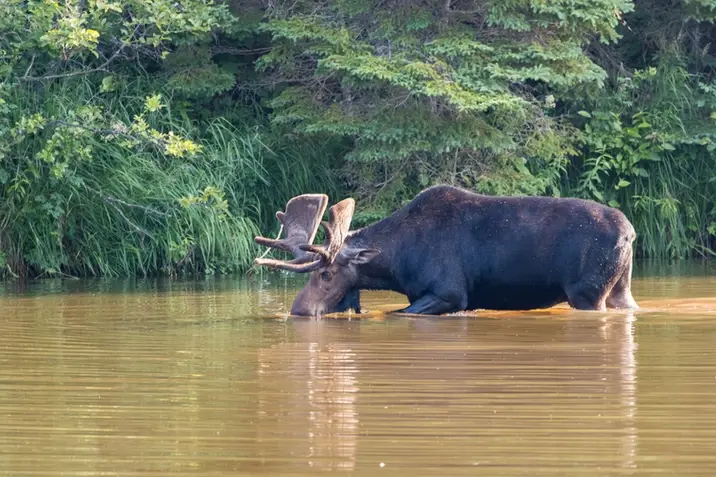
Are there bears on Isle Royale?
There are no bears on Isle Royale. There are also no coyotes, mountain lions or porcupines. Wolves have been the only island apex predators of moose and beaver since the late 1940s. Prior to both the moose and wolf populating the island, it was inhabited by caribou and lynx.
Will you see a moose?
Many backpackers see moose, but no sighting is guaranteed. Observe quietly from a distance. When a moose blocks the trail, back away and allow it to move rather than attempting a close pass. Give extra space to cows with calves.
Ranger Chris Amidon describes the experience in the Lake Superior Podcast episode on trip planning, wildlife and wilderness safety: “Encountering a moose is a really magical moment.”
What should you do if you see a wolf?
Wolves generally avoid humans, but you can learn what to do from the NPS safety page if you see one. The park's current wolf guidance provides additional instructions.
Do not run or approach. If a wolf remains close or approaches, back away, make noise and make yourself appear large. Report unusual behavior to park staff and never approach a carcass where wolves may be feeding.
Help preserve Isle Royale
The park asks visitors to pack out all trash and leftover food, use established sites, leave rocks and cultural objects where they are found, and keep noise low. Campfires are permitted only at a limited number of campgrounds, so a backpacking stove is recommended. Feeding, touching, teasing or intentionally disturbing wildlife is prohibited. The seven Leave No Trace principles also provide a useful framework.
A Journey of Discovery and Connection

Prain’s insights offer a glimpse into the magic and allure of Isle Royale.
By embracing the challenges and the beauty of Isle Royale, every traveler can embark on a journey of discovery, connection, and appreciation for the natural world.
One of the key pieces of advice Prain shares is the mantra of "less is more." Instead of rushing through the trails and focusing on checking off landmarks, taking the time to savor each moment and truly connect with nature can elevate the entire experience. By slowing down and immersing oneself in the sights and sounds of Isle Royale, visitors can gain a deeper appreciation for the island and all it has to offer.
Ranger Chris Amidon reaches the same conclusion in the Lake Superior Podcast episode on trip planning, wildlife and wilderness safety after helping thousands of visitors plan trips: people commonly say they wish they had one more day, while no one complains about spending too much time on the island.
For more Isle Royale insights, check out Jon Prain's website. His full Isle Royale Guy interview combines route preferences with decades of experience testing gear and returning to the same wilderness in different conditions.
The National Park Service also publishes Isle Royale’s annual Greenstone Newspaper for all you need to know about visiting the park and a special “first-timer guide”.
More Isle Royale stories from NPLSF
The island's visitor experience is connected to ongoing cultural, historic and sustainability work.
Explore the Minong exhibit at Hat Point, the story of new solar power for key Isle Royale services, the arrival of electric cargo bikes for park operations, and the history uncovered through a unique apple tree at Windigo/Ozaagaateng.
Recent preservation work also includes the Fisherman's Home cleanup and projects improving resilience across Lake Superior's parks. The Isle Royale Heritage Alliance is also bringing people together to preserve the historic places and stories that help make Isle Royale distinctive. Learn more about volunteering on Isle Royale here.
###
About The Lake Superior Podcast and NPLSF

The Lake Superior Podcast is a project of the National Parks of Lake Superior Foundation (NPLSF), the official nonprofit friends group for Lake Superior’s five national parks: Apostle Islands National Lakeshore, Grand Portage National Monument, Isle Royale National Park, Keweenaw National Historical Park, and Pictured Rocks National Lakeshore.
Funded through grants and private donations, NPLSF projects and programs ensure that these great parks and historic sites are maintained, improved, and celebrated for the enjoyment of all current and future visitors. For more information, contact us at info@nplsf.org.
More Information On Isle Royale
Isle Royale entrance fees and passes
The park entrance fee is $7 per person for each calendar day spent in the park, including arrival and departure days. Visitors age 15 and younger are exempt. The $60 Isle Royale Season Pass covers the passholder and up to three accompanying adults; federal recreation passes are also accepted. Entrance-fee transactions in the park are cashless.
See the National Park Service’s current fee and pass information before purchasing.
Backcountry permits, campgrounds and shelters
Every overnight visitor needs a backcountry permit. Parties of one to six receive a free permit on arrival at Rock Harbor or Windigo, or aboard Ranger III. These small-party campground stays are first-come, first-served; the itinerary on a permit is not a campsite reservation. Groups of seven or more require an advance group-camping reservation and a $25 permit. Review the park’s current camping and permit rules before traveling.
Camp only in designated campgrounds unless you have obtained the separate cross-country camping addendum and meet the park’s off-trail camping requirements. Posted stay limits vary by campground.
Three-sided shelters are available at some—but not all—Lake Superior shoreline campgrounds. They cannot be reserved. Always carry a tent or other freestanding shelter, even if you hope to use a park shelter. Busy campgrounds may require sharing a tent site or following the park’s overflow sequence; courtesy and flexibility are part of island camping.
Food storage rules
Food-storage lockers have been allocated to all campgrounds. Allocation does not eliminate the need to check the current food-storage page and campground locker table before departure. A personal approved hard-sided canister provides a backup if a locker is full, unavailable or damaged.
Soft-sided bags—including Ursack-style bags and dry bags—are acceptable only when placed inside a park locker. Do not hang food at a designated campground, store food in a tent or shelter, or leave food or a food-laden pack unattended. Put the food, trash, toiletries and other scented items in the locker; do not place an entire backpack, stove or fuel container inside.
Isle Royale has no bears, but gray jays, squirrels, foxes, mice and other wildlife are skilled food thieves. The updated rules also respond to a small number of wolves that have obtained human food and become habituated around campgrounds. Never feed or entice any animal.
Treat all backcountry drinking water
Potable water is normally available only at Rock Harbor and Windigo/Ozaagaateng while those systems are operating. The other campgrounds rely on Lake Superior, inland lakes or streams. Island Mine’s stream can be intermittent, and any source may be affected by weather or harmful algal blooms. Check current conditions for outages and advisories.
The National Park Service lists four acceptable backcountry treatment methods:
Use a physical water purifier rated to remove viruses.
Pass water through a filter rated to 0.4 microns or finer, then chemically disinfect it.
Pass water through a filter rated to 0.4 microns or finer, then treat it with ultraviolet light.
Bring water to a rolling boil for at least one minute.
Chemical treatment alone is not enough for Isle Royale’s hydatid tapeworm risk. No backpacking filter, purifier, chemical or UV device makes water containing cyanobacterial toxins safe. Avoid water with visible scum, unusual color or a bad odor and use another source. Read the park’s complete drinking-water guidance.
Things To Do In Isle Royale National Park
Due to its isolation, Isle Royale is the least-visited national park in the contiguous United States. But there’s still an abundance of activities to enjoy!
Hiking Isle Royale
Learn all about hiking on Isle Royale in The Lake Superior Podcast interview with “The Isle Royale Guy”.
Canoeing, Kayaking and Boating Isle Royale

Isle Royale is a dream destination for canoeing and kayaking, boasting extensive waterways, including inland lakes, bays, and islands. You can bring your own canoes and kayaks on one of several ferry options.
Isle Royale is popular with big lake motorsailers, cruisers and cabin catamarans as well as motor yachts, trawlers and flying bridge cruisers. There are docks throughout the park that are accessible to outside boats though permits are required for overnight visitors.
During the operational season of Isle Royale Resorts, you can rent canoes and kayaks at both Rock Harbor and Windigo, ready to embark on your water adventure. Contact Isle Royale Resorts for more information about rentals and check out the NPS page on kayaking and canoeing.
Fishing At Isle Royale
Some of the best fishing - both on the big lake and interior island lakes - takes place at Isle Royale National Park. A paradise for fishing enthusiasts, Isle Royale National Park boasts remarkable diversity, with over 40 recorded fish species inhabiting its waters. The wide array of fish species includes lake trout, brook trout, lake whitefish, northern pike, yellow perch, walleye, salmon, rainbow smelt, cisco, lake chub, slimy sculpin, burbot, pearl dace, fathead minnow, and trout-perch.
Whether you’re casting a line in Lake Superior or the inland lakes, using a boat, canoe, kayak, or simply fishing on foot, the park offers first-rate fishing opportunities.
Ranger Programs
As a national park, educating visitors is a priority at Isle Royale. The Park Rangers are renowned experts and can be joined for a talk via a Ranger Program at both Rock Harbor and Windigo.
Isle Royale Shipwrecks
Isle Royale National Park is home to ten shipwrecks that are officially listed on the National Register of Historic Places. Learn more about scuba diving, check out a dive site map, and listen to a podcast episode about Lake Superior shipwrecks.
Isle Royale Lighthouses
There are 4 lighthouses within the national park - the Rock Harbor Light, the Isle Royale Light, the Rock of Ages Light, and the Passage Island Light.
Although no longer illuminated, the Rock Harbor Lighthouse is the oldest lighthouse on the island. Located at the entrance to Rock Harbor in Isle Royale National Park, visitors can explore self-guided exhibits, offering a wealth of information and insights.

Isle Royale Restaurants
While most boaters and backpackers bring their own provisions to Isle Royale, the Rock Harbor Lodge features two dining options: the Lighthouse Restaurant and the Greenstone Grill. For those in need of essentials, camp stores in both Rock Harbor and Windigo provide a selection of basic supplies. Learn more and check opening hours here.
Places To Stay On Isle Royale
While day trips are possible, several hours on the island is simply not enough to get the full Isle Royale experience.
The majority of park-goers decide to set up camp at one of the park's 36 campgrounds (permits are required). Learn more about camping on Isle Royale.
There are alternatives to camping. You can stay in a room or cabin at the Rock Harbor Lodge or rent a camper cabin in Washington Harbor. They do book up, so make sure you reserve in advance.
If you arrive by private boat, you can also dock your boat and sleep there for the night (permits are required).
Isle Royale FAQ
How long does it take to backpack Isle Royale?
A full Greenstone Ridge crossing generally deserves five to eight days. Feldtmann takes four to five days, Harbor to Hills five to six days, and the official Minong Ridge itinerary about five demanding trail days. Transportation days are additional.
How many miles should you hike each day?
The National Park Service says most Isle Royale backpackers travel about six to eight miles a day. That is a better planning baseline than comparing the island with smoother mainland trails.
Progress can be slowed by wet roots and bedrock, mud, standing water, narrow boardwalks, dense vegetation, downed trees, beaver activity, heat on inland ridges and cold wind near Lake Superior. A moose occupying the trail may also require patience rather than a close pass.
Strong hikers can cover more, but the itinerary should be built around the slowest realistic day and the least experienced party member. The Greenstone mileage chart provides distances between campgrounds.
How long does it take to hike across Isle Royale?
Most hikers should allow approximately six to eight trail days for an end-to-end Greenstone route that includes Rock Harbor and Windigo/Ozaagaateng. Faster trips are possible, but they provide less flexibility and little room for weather or fatigue.
What are the best Isle Royale backpacking routes?
Greenstone Ridge is best for a classic crossing, Feldtmann for varied western scenery, Harbor to Hills for a first multi-day trip and Minong Ridge for experienced hikers seeking primitive terrain.
Is Isle Royale difficult to hike?
Yes. Rocks, roots, mud, boardwalks, downed trees and changing weather make the island slower than mileage alone suggests. Minong Ridge adds route-finding and long remote stages.
Can a beginner backpack Isle Royale?
A fit beginner with tested overnight equipment and previous camping experience can consider a conservative Harbor to Hills or basecamp itinerary. Isle Royale is not a good place to use an unfamiliar tent, stove, backpack or footwear for the first time.
Can you camp anywhere on Isle Royale?
Most backpackers must camp in designated campgrounds. Off-trail camping requires an additional permit addendum and separate food-storage practices.
Do you need a permit to backpack Isle Royale?
Yes. Every overnight stay requires a permit. Parties of six or fewer receive a free permit upon arrival; groups of seven or more need advance reservations.
How much does it cost to backpack Isle Royale?
The park entrance fee is $7 per person per day, with passengers under 16mo exempt. Small-party camping has no separate fee, but ferry or seaplane transportation can be the largest trip expense.
What equipment is necessary for a five-day Isle Royale backpacking trip?
Core gear includes a weather-resistant tent with a waterproof rainfly and ground protection, sleeping system for cold nights, rainwear, tested water purification, food storage that meets current rules, stove, navigation tools, first aid, insect protection, repair supplies and an extra day of food.
Is there cell service on Isle Royale?
Cell service is unreliable and should not be part of an emergency plan. Download all maps and travel details before the crossing.
Are there bears on Isle Royale?
No. Food lockers and approved hard-sided containers are required because many other animals, including foxes and wolves, can become conditioned to human food.
Which way should you hike Greenstone Ridge?
Either direction works. Choose based on transportation times, first- and final-day mileage, and whether you prefer to finish near the broader services at Rock Harbor.
What is the hardest trail on Isle Royale?
Minong Ridge is generally regarded as the most challenging established trail because it is primitive, lightly maintained and requires strong navigation skills.
What is the best time to backpack Isle Royale?
July and August offer the fullest transportation season. June provides long days with more insects and potentially wet trails, while September offers cooler, quieter hiking with fewer services and shorter days.
Where can you get official help planning an Isle Royale trip?
Use the first-timer guide, the current Greenstone and the official map collection. Visitors with unresolved questions can call the Houghton Visitor Center at 906-482-0984 and speak with a ranger.
Does anyone live on Isle Royale?
Isle Royale has no permanent residential community. Park employees, concession staff and researchers stay on the island seasonally or temporarily. Isle Royale's remoteness and harsh climate have always made it a difficult place to live. Isle Royale's prehistoric record began about 4,500 years ago in the Archaic stage. Isle Royale has a long history of Indigenous travel, fishing, hunting, gathering and cultural use. There has been a continuous record of human habitation, albeit limited, on the island up until the 1930's.
What is the cheapest way to get to Isle Royale
The least expensive way to visit Isle Royale is to take a day trip aboard Sea Hunter III from Grand Portage, MN to Windigo. In 2026, the same-day fare is $120.50 for adults and $110.50 for passengers under 16. This is explicitly a non-camper fare and cannot be used by overnight backpackers. Parking and park entrance fees are additional.
Check here for more information on prices and additional fees for bringing excess equipment, kayaks, bikes, canoes, etc.


